Public Transport in Nigeria: Buses, Motorcycles and Taxis
Getting around Nigeria is an experience in itself. The country has no functioning national rail network for passenger travel, no intercity subway, and roads that range from excellent to genuinely hazardous. What it does have is one of the most inventive, layered, and chaotic informal transport ecosystems in Africa — a system that moves tens of millions of people every day through a combination of official infrastructure, private enterprise, and pure improvisation.
This guide covers every mode of transport you will encounter in Nigeria as a traveler, from the iconic yellow danfo minibuses of Lagos to intercity coaches, motorcycle taxis, ferries, and ride-hailing apps — with honest assessments of what each is like to use, what it costs, and when each option makes sense.
Looking for accommodations? You will be redirected to Booking.com to check availability and prices. 🏨
Check Hotels & Prices →Understanding the Landscape: Lagos vs. Everywhere Else
Nigeria’s transport picture divides sharply into two realities.
Lagos has more transport infrastructure than any other Nigerian city — a Bus Rapid Transit system, the beginnings of a metro rail network, an expanding ferry service, and a dense web of informal bus routes covering virtually every corner of the city. It is still chaotic, but it is layered chaos with multiple options at any point.
Every other Nigerian city relies far more heavily on informal and semi-formal transport: shared minibuses, motorcycle taxis, tricycle taxis, and private vehicles. The further you travel from Lagos and Abuja, the more improvised and sparse the options become.
Both realities are navigable. Neither is particularly comfortable by Western standards. Both are entirely workable with the right knowledge.
Danfo: The Yellow Minibus That Runs Lagos
The danfo — a battered yellow minibus with room for up to 18 passengers — is the most common vehicle on Lagos roads, careening down main roads and threading through traffic with reckless efficiency. Nigeriansearchguide There are an estimated 75,000 danfos operating in Lagos alone Rogue Wanderers , and they collectively carry the majority of the city’s daily passenger traffic.
Danfos are the driving force of public transportation in Lagos, powering commuting in and around the city. They operate everywhere, taking turns to pick up passengers in garages, designated motor parks, roadsides, lay-bys and bus stops. Lagosians hail and board them at all these places, and routes have fixed prices. Conductors collect fares as soon as the bus is on the move; at other times, passengers pay just before they get off. If you don’t have the exact fare, you can pay with a higher denomination note and receive change from the conductor. Ioverlander
Danfo buses display their destinations on boards placed in front. Common routes include Oshodi to CMS, Ojuelegba to Yaba, and Ikeja to Agege. Listen to the conductor — the bus conductor, known as “agbero,” announces destinations and collects fares. Always carry small bills as drivers often do not have change. Travel.gc.ca
What Riding a Danfo Is Actually Like
The ride is often uncomfortable and chaotic: hot, loud, and unpredictable. Nigeriansearchguide Seats are cramped, windows may not open, air conditioning does not exist, and the driving style requires a level of faith in physics that first-time passengers rarely possess. One researcher who spent months mapping danfo routes in Lagos noted that fellow passengers had survived three or four incidents where the bus they were riding actually caught fire. Yet the same researcher acknowledged: danfos are the quickest way to get around Lagos for many journeys.
For foreign travelers, the danfo is an extraordinary cultural experience and a genuinely useful transport option — once you understand the system. The challenge is that routes are not mapped in any accessible way, stops are not marked, and everything is communicated verbally and locally. As one Lagos resident put it: “I step out from my house and I find a danfo, a keke, a korope. You don’t have to walk far. It’s accessible and affordable.” Nigeriansearchguide But finding the right danfo for your destination as an outsider requires either a local guide or a willingness to ask and ask again until you find someone who points you in the right direction.
Cost: Danfo fares are among the cheapest in the world — typically ₦100 to ₦500 for most city routes depending on distance.
BRT: The Sensible Option When It Goes Where You Need
The Lagos Bus Rapid Transit system has become an integral part of the city’s public transport network, replacing many of the older molue and danfo buses. The BRT operates on dedicated lanes, giving it a slight edge over the usual congestion on Lagos roads. Buses are colour-coded in red or blue and connect key areas like the mainland and islands. Smartraveller
The BRT initiative in Lagos is the closest thing to accessible, organized public transport in Nigeria. It operates with hundreds of high-capacity buses on dedicated lanes, helping to reduce road congestion. Thinking Nomads
For travelers, the BRT has three significant advantages over danfos: it is more comfortable, it runs on fixed published routes, and it uses a ticketing system that removes the need for cash negotiations. Lagos is the only state in Nigeria with anything close to a transport pass. The Cowry Card works on the city’s integrated transport network and can be used on the BRT corridor, ferry services, and the newly introduced light rail. Thinking Nomads You can get a Cowry Card at any BRT terminal and top it up there. Tripadvisor
The limitations are real: BRT buses don’t serve the Lekki-Victoria Island-Ikoyi perimeter Tripadvisor — exactly where many foreign visitors spend most of their time. Queues get long during peak hours, and the system does not yet cover most of Lagos’s residential neighborhoods. In many cases, danfos serve as informal feeders into BRT stations, delivering passengers from inner neighborhoods to formal corridors — most Lagosians rely on a layered mix of all modes to get where they’re going. Nigeriansearchguide
Cost: BRT fares are subsidized and considerably cheaper than equivalent danfo journeys — typically ₦300 to ₦800 depending on route length.
The Lagos Metro Rail: New and Still Growing
Lagos now has the beginnings of a metro rail network, which is genuinely exciting even if its current coverage is limited.
The Blue Line is the first rail line in the network, covering 27 km from Okokomaiko to Marina. The first five stations officially opened in September 2023. The Red Line, running from Agbado to Marina, opened in February 2024. This line shares right-of-way with the Lagos–Kano Standard Gauge Railway and is expected to play a critical role in the city’s transport ecosystem. Smartraveller
The rail network uses the Cowry Card — the same card as the BRT and ferry services — which is a genuine step toward integrated transport. Coverage is still limited, and for most of Lagos’s geography the trains are not yet a primary option. But the Marina-to-Mile 2 Blue Line section is a great way to see Lagos from a whole new angle Thinking Nomads , and for specific routes it offers a reliable, congestion-free journey that nothing else in Lagos can provide.
Lagos Ferries: Underused, Underrated
Lagos sits on a lagoon with extensive waterways, and the ferry system offers something genuinely valuable: an escape from road traffic entirely.
The Lagos State Government is investing in water transport, adding new ferries to boost services and reduce road congestion. The ferry service uses the Cowry Card like the BRT and rail. Smartraveller Peak boarding periods are between 6:30 am and 9 am, and 3:30 pm and 5 pm. The waterways close by 6 pm. Tripadvisor
The ferry is particularly useful for crossing between Lagos Island and the mainland — a journey that by road can take anywhere from 30 minutes to two hours depending on traffic, but by water takes a fraction of the time. For travelers staying on Victoria Island or Lagos Island and needing to reach the mainland (or vice versa), the ferry is worth knowing about.
Okada: Motorcycle Taxis
To get to a destination fast, Nigerians skip the traffic on an okada (motorcycle taxi, known as achaba in the north). Motorcycle taxis are found practically everywhere — usually at dedicated spots on neighborhood streets and on main roads. Riders typically wear uniforms, which differ from state to state, but the most common is a short-sleeved reflective jacket. Thinking Nomads
Okadas are fast, cheap, and available on almost every street corner in Nigerian cities and towns. They are also the transport option most associated with accidents. Riding on an okada can be an adrenaline-filled experience, as drivers often weave through traffic at high speeds and may not always follow the rules of the road. Smartraveller
Due to safety concerns, the Lagos government has restricted okadas in many areas, especially in the city centre and on highways. Smartraveller Okadas have been banned outright in several states including Kaduna, Akwa Ibom, Kano, Rivers, Enugu, and the Federal Capital Territory (Abuja). In Lagos, they are restricted to suburban areas and banned from 475 roads including major highways and bridges. Thinking Nomads
In smaller cities and rural areas where these bans don’t apply, okadas remain a primary means of reaching neighborhoods that other vehicles can’t access. If you use one: agree on the price before mounting, confirm the helmet situation (required by law but rarely enforced), and hold on.
Cost: ₦200 to ₦800 for most short urban trips, negotiated in advance.
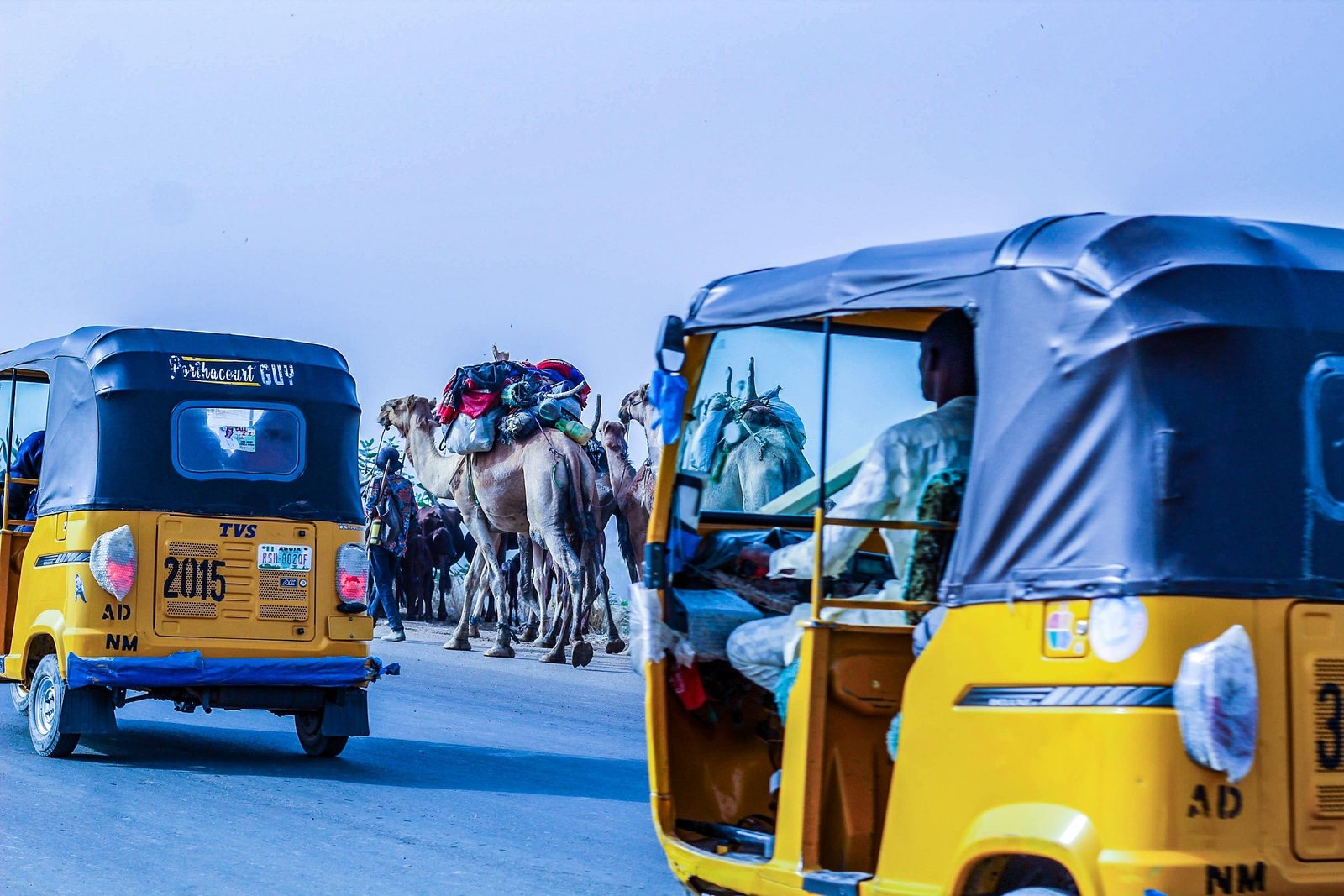
Keke NAPEP: The Tricycle Taxi
In many Nigerian cities, kekes (tricycles) complement okadas in shuttling residents around. Safer and more fun than an okada, kekes are good for short rides that last less than half an hour. In places where okadas have been banned, such as private estates and gated residencies, kekes are the only alternative. Thinking Nomads
Three-wheeled motorized rickshaws, introduced to the city’s transport mix more than 20 years ago, are great for neighborhood shuttles. Ioverlander They seat three passengers comfortably, move slower than okadas, and provide a degree of shelter from the elements. For first-time visitors to Nigerian cities who want something between a full taxi and a motorcycle ride, the keke is often the sweet spot.
Some cities enforce a curfew on kekes — they must be off the road at 6 pm in Jos and 9 pm in Lagos. Thinking Nomads Plan accordingly if you are relying on keke transport in the evening.
Cost: Similar to okadas — ₦200 to ₦600 for most short trips, agreed beforehand.
Ride-Hailing Apps: Uber, Bolt, and inDrive
For foreign travelers in Lagos and Abuja, ride-hailing apps are the single most important transport tool. Apps like Uber and Bolt are common in Nigerian cities. Don’t wave down random taxis — stick to verified drivers and always share your ride details with someone you trust. Smartraveller
All three major apps — Uber, Bolt, and inDrive — operate in Lagos and Abuja, with Bolt and Uber also present in Port Harcourt and some other major cities. The apps eliminate price negotiation, provide driver identification and vehicle details before you enter, and create a digital trail of your journey. For safety reasons alone, these advantages make them worth any small premium over street taxis.
Some practical realities as of 2025: economic pressures, reduced driver incentives, and soaring vehicle and fuel costs have forced many operators to rely on older, poorly maintained cars — often with torn seats, faulty air conditioning, and high mileage. Tour with MiCi The Lagos State Government ordered a mandatory roadworthiness audit of all ride-hailing vehicles in August 2025, with representatives from Uber, Bolt, Lagride, InDrive, and others committing to enhanced driver verification, mandatory licence checks, panic buttons, and stricter onboarding processes. Alarinka Vehicle quality has been variable — check the car before getting in and cancel if something feels wrong.
LagRide is the Lagos State Government’s own ride-hailing platform, launched to provide an alternative to international apps. LagRide drivers can now operate across Uber, Bolt, inDrive, and other e-hailing apps Medium , so you may find LagRide-branded vehicles appearing when you book through standard apps. The service is most relevant in Lagos specifically.
inDrive operates on a negotiated pricing model where passengers propose a fare and drivers accept, counter, or decline — a format that experienced local users navigate well but can be confusing for first-time users unfamiliar with fair price ranges.
Cost: Bolt tends to be cheapest for equivalent trips in Lagos; Uber slightly more expensive; inDrive variable depending on negotiation. A typical 10 km trip in Lagos: ₦1,200 to ₦2,500 depending on app, time of day, and traffic.
Intercity Buses: Getting Between Cities by Road
For travel between Nigerian cities, several bus companies offer scheduled coach services that are significantly safer and more comfortable than danfos or informal shared taxis.
ABC Transport is the most established intercity bus company in Nigeria, operating on routes connecting Lagos, Abuja, Benin City, Owerri, Enugu, Port Harcourt, and other major cities. Tickets can be booked online at abctransport.com, which makes advance planning possible. The coaches are air-conditioned, seats are assigned, and the service runs on approximate schedules — a meaningful step up from informal transport.
GUO Transport, Chisco Transport, and Young Shall Grow are other reputable intercity operators with established route networks. Each has bus terminals in major cities where tickets are sold in person, and increasingly online through booking platforms like intercity.ng.
The critical rules for intercity bus travel apply regardless of operator: never travel after dark, plan journeys to arrive at your destination well before sunset, and avoid road travel in regions with elevated security concerns. Even on reputable operators, road safety across Nigeria is poor relative to most international standards. The coaches themselves are safer than informal transport, but the roads and other drivers are the same for everyone.
Cost: Lagos to Abuja by ABC Transport: approximately ₦7,000 to ₦12,000 depending on service class and booking timing. Lagos to Benin City: approximately ₦4,000 to ₦6,000.
Domestic Flights: Often the Right Answer
For distances of more than 300 to 400 km — Lagos to Abuja, Lagos to Port Harcourt, Abuja to Kano — domestic flights are worth serious consideration. The time saved is substantial, the safety profile is meaningfully better than road travel, and fares on the main routes are reasonable.
Nigerian carriers operating domestic routes include Air Peace, Ibom Air, and United Nigeria Airlines. Lagos (Murtala Muhammed), Abuja (Nnamdi Azikiwe), Port Harcourt, Enugu, and Kano are the main hubs with regular service. Smaller cities have less frequent connections.
Nigerian domestic aviation has a mixed safety record historically — the sector has seen serious accidents over the years. That said, road travel in Nigeria carries substantially higher statistical risk than domestic flying, and for travelers weighing the options, the plane is almost always safer than the road for long-distance intercity travel.
Book in advance during busy periods (December especially) as flights fill quickly and last-minute fares are expensive. Domestic check-in is relatively informal by international standards, but arrive at least 90 minutes before departure at Lagos airport to allow for security queues.
Outside Lagos: What to Expect in Other Cities
In Abuja, the transport picture is simpler and calmer. Uber and Bolt operate reliably, roads are better maintained, and the city’s planned layout means distances are more predictable. Okadas are banned in Abuja, so kekes and taxis fill the gap for short trips in neighborhoods.
In Port Harcourt, Enugu, Ibadan, Benin City, and other major cities, the pattern is broadly similar to Lagos but smaller in scale — danfos or their local equivalents for short hops, okadas and kekes for neighborhood trips, ride-hailing apps in the city center, intercity coaches for longer journeys.
In smaller towns and rural areas, transport becomes improvised. Shared taxis (cars taking four to five passengers on fixed routes), motorcycle taxis, and occasional minibuses are what exist. Schedules are non-existent — vehicles depart when full. Have time, patience, and small change.
Quick Reference: Which Transport When
| Situation | Best Option |
|---|---|
| Airport to hotel in Lagos or Abuja | Pre-booked hotel transfer or Uber/Bolt |
| Getting around Lagos city center | Uber or Bolt for safety; BRT for budget |
| Short neighborhood trip | Keke NAPEP (safer than okada) |
| Lagos Island to mainland quickly | Ferry (avoids road traffic entirely) |
| Between major cities up to 400km | ABC Transport or equivalent intercity coach — daylight only |
| Between major cities over 400km | Domestic flight |
| Exploring a neighborhood on foot | Safe in tourist areas of VI and Ikoyi — ask your hotel about specific streets |
A Final Honest Note
Nigerian public transport will not feel like public transport in Europe, North America, or East Asia. It is loud, crowded, unpredictable, and occasionally alarming. It is also part of the texture of daily life in one of the world’s most energetic urban environments, and using it — even occasionally — gives you a window into how the city actually functions that no hotel lobby or ride-hailing app can provide.
Use Uber and Bolt for safety and convenience. Try the BRT or a danfo once if you want to understand Lagos from the inside. Let a keke take you through a neighborhood that no big car can navigate. And for anything intercity, always choose daylight, choose a reputable operator, and choose a flight when the distance and your schedule allow.
📌 Transport regulations, route availability, and operator schedules change. Okada and keke restrictions vary by state and are updated regularly. Always check current local conditions. Last updated March 2026.
Published on seekroutes.com — Overland and Sea Routes in Africa and Beyond.
Want to make your trip unforgettable? You will be redirected to GetYourGuide for top-rated tours, excursions, and experiences. 🌍
Discover Tours & Activities →